Anthropic has raised enough money to finance a technological ambition of extraordinary scale. Whether that ambition produces an equally extraordinary business is a different question.
The company behind Claude began trading on Nasdaq on 19 November 2026. Its final IPO prospectus estimates approximately $104.8 billion in net proceeds from the public offering and concurrent private placement, subject to closing. Its fully diluted market valuation was reported at approximately $1.77 trillion after the first trading day. This valuation counts a broader potential share base than figures based solely on outstanding shares. Reuters reported on the debut and the valuation.
These are not interchangeable numbers. Proceeds are new financing for the company; market capitalisation reflects a price placed on its equity. Neither establishes future earnings, productive impact or control over the AI economy.
The prospectus reports approximately $900.9 billion of aggregate purchase commitments and lease agreements, substantially related to compute and infrastructure. Approximately $451.6 billion is expected to be incurred before the end of 2030, with substantially all the rest expected between 2031 and 2045. Commitments differ in cancellation terms, timing and conditions; they are neither today's expenditure nor an unconditional fixed cash bill of identical rigidity.
Anthropic is making an industrial-scale bet on intelligence before anyone can know with confidence how much of the economic value created by that intelligence its shareholders will capture.
The capital buys capacity, not immunity
The $104.8 billion estimate includes a concurrent private placement and is not the value of the company's stock. The prospectus separately reports $146.6 billion of liquidity at 30 September 2026, including undrawn credit capacity. These figures refer to different dates and definitions and cannot simply be added.
The financing gives Anthropic unusual room to invest in model training, data centres, researchers and distribution. Yet commitments of the disclosed magnitude can be an advantage or a liability. Strong utilisation could produce economies of scale; weaker demand or rapidly declining inference prices could leave the company carrying costly infrastructure while customers capture much of the benefit.
Financial endurance matters. So does the distinction between demand for AI and the returns earned by the companies financing it. A larger AI market does not guarantee attractive economics for every model provider.
From answers to completed work
The company's product direction is more revealing than its valuation. Anthropic has emphasised Claude Code, autonomous capabilities and tools for enterprise use, including its concept of Virtual Collaborators. Its ambition is not merely to provide better answers. It is to make AI systems capable of completing increasingly complex assignments.
Software development offers an advantageous starting point. Code can be executed, tested and corrected; at least some failures can be detected automatically. Certain mathematical, data-processing and tool-use tasks have similar properties. These verifiable feedback signals can support evaluation and further training, including reinforcement-learning methods.
But a strategic focus on verifiable work does not reveal Anthropic's full training-data composition, the contribution of particular algorithms or proprietary model-development decisions. Public product priorities are evidence of direction, not a complete map of the training process.
If agents become dependable, the unit of economic value changes. Rather than paying for each question, a customer could pay for an accepted piece of work: software shipped, records reconciled, a case processed or an analysis delivered and checked. The important metric would be quality-adjusted cost per completed result, including human review, failed attempts, rework and exceptions.
Where an advantage could spread
Software engineering is the nearest extension of today's capabilities. From there, agentic systems might maintain applications, triage failures, operate tools and perform constrained tasks in complex enterprise systems. Cybersecurity is adjacent but particularly sensitive because an ability to find weaknesses can help both defenders and attackers.
Enterprise operations may offer a larger economic opportunity than coding assistance alone. Consider an insurance case that currently moves between multiple employees and systems. An agent might gather the records, identify conflicting information, prepare a decision under defined rules and leave an auditable trail. The institution would retain responsibility for the result even where the model performed much of the work.
Professional services provide another possible market. In law, finance, accounting and advisory work, some research, drafting and routine analytical production can be automated. But client relationships, specialist information, legal responsibility and authority to act often remain with established organisations. Those firms may take the margin from AI-enabled productivity while buying the underlying model as an increasingly interchangeable input.
Scientific research and AI development present greater potential but greater uncertainty. Generating code for an experiment is not the same as independently devising, evaluating and validating a consequential discovery.
None of these possibilities supports a forecast that Anthropic will monopolise the relevant industries. Rival model suppliers, open-weight systems and distributors with direct customer access can prevent technological leadership from becoming durable market control.
The research loop is the consequential unknown
Advanced AI already helps humans write code, review experiments and analyse results. More autonomous research assistance is an active frontier. The much stronger proposition — that AI can reliably design and develop substantially more capable successor systems with little human direction — remains unproven as a sustained, independently validated process.
The distinction is consequential: money and research automation operate differently. Capital expands the resources available. Reliable research acceleration would change the amount of progress those resources can produce.
If that second development occurs, it could increase the pace of model improvement. It would also heighten questions about safety, oversight and the concentration of technological power. Treating the outcome as possible is prudent; treating it as already achieved is not.
The strongest objection: indispensability may not pay
The most damaging objection to Anthropic's valuation does not require AI to fail. Advanced AI could become pervasive while competition limits the ability of individual model suppliers to charge a premium.
Businesses can route work among multiple models, use open-weight alternatives and keep control of the workflow and customer relationship. Microsoft, Google, Amazon and other established platforms also possess distribution, compute and data advantages. Some of these companies simultaneously act as suppliers, partners, investors and competitors in the AI economy.
Financial results underline the uncertainty. The prospectus reports $33.242 billion of revenue and a $104.039 billion net loss for the nine months ended 30 September 2026. The headline net loss contains very large accounting effects; the filing separately reports an operating loss of about $1.3 billion for that period. Neither figure alone establishes the future cash economics of the infrastructure programme.
At a valuation of around $1.77 trillion, investors are paying for a substantial continuation of growth and eventual value capture. The company could become embedded across the economy and still disappoint shareholders if competing providers drive down prices faster than demand and efficiency improve.
A technology can become essential to an industry without allowing its creator to collect most of the value that industry produces. That is the central counterargument to the investment thesis, not an afterthought.
The test for 2027–2031
Five measures would help distinguish an enduring infrastructure position from an expensive period of adoption:
- Sustained autonomy: the share of consequential tasks completed correctly without intervention, over meaningful time horizons.
- Cost per accepted outcome: expenditure on inference, orchestration, review, rework and exceptions relative to an accepted result.
- Research productivity: independently assessed evidence that AI meaningfully shortens the development cycle of new capabilities.
- Depth of integration: recurring use in core business processes, not only seats, registrations or API calls.
- Value capture: durable cash returns after compute, distribution and continuing capital costs, rather than gross adoption alone.
These are proposed tests, not forecasts with calibrated probabilities. A future assessment should date its measurements and disclose the tasks, denominators and reliability criteria.
Conclusion: The invisible network
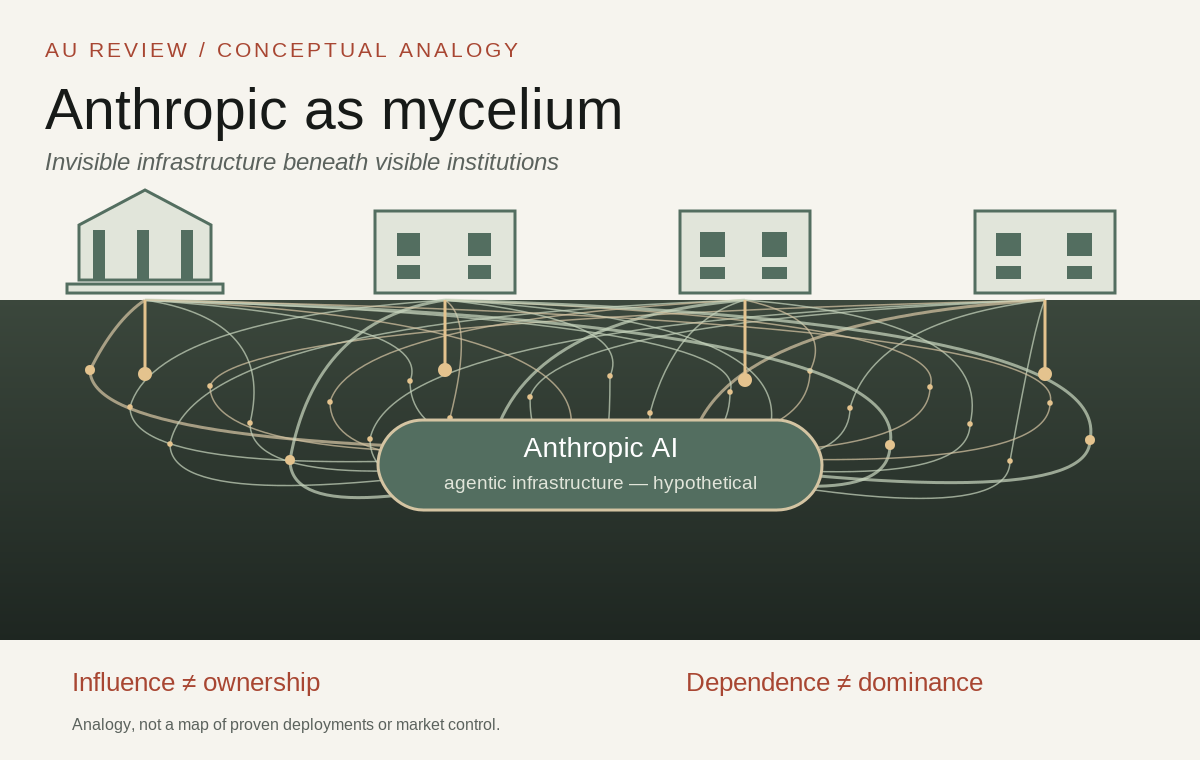
The most consequential technology is not always the most visible.
Anthropic may eventually occupy a position resembling mycelium: a network growing largely out of sight, connecting otherwise separate systems and participating in the exchange of resources on which they depend.
Mycelium does not own the forest. Fungal relationships with other organisms can be cooperative, competitive or exploitative. The network's influence depends on its connections; the connections also make it dependent on its environment.
Anthropic could develop a comparable relationship with the institutions adopting its intelligence. A bank might use it to process decisions. A software company might use it to build and maintain products. A laboratory might rely on it to design experiments. Each institution would remain visible while some of its cognitive work was carried out by systems supplied elsewhere.
That possibility raises questions beyond corporate valuation. Who controls systems on which institutions increasingly rely? Who can inspect their decisions? Who has the power to switch providers when the arrangement ceases to serve the institution or the people affected by its actions?
These questions explain why the possibility matters. They do not prove that Anthropic will become indispensable.
We can observe the financing, the contractual commitments, the company's publicly stated strategy and a rapidly developing market for productive AI. We can infer that Anthropic seeks to become a major supplier of increasingly autonomous digital work. We cannot yet know whether it will maintain technical leadership, secure durable customer dependence or capture a high proportion of the value its systems create.
The strongest alternative remains plausible: AI becomes pervasive, models become more interchangeable, and the largest profits accrue to businesses that own customer relationships, proprietary data and distribution. The mycelium analogy is therefore a way of thinking about influence, not a prediction of corporate destiny.
Three propositions must remain separate: AI spreads; institutions depend on it; one provider profits disproportionately from that dependence. Each requires different evidence.
Anthropic may help build infrastructure through which an extraordinary volume of human work is performed. Whether it controls that infrastructure or becomes one replaceable component within it remains unresolved.
The question is not simply whether Anthropic can become indispensable. It is whether indispensability will give it power — and whether that power will be visible, accountable and economically durable.
The forest may come to depend on networks it rarely sees. But no single network owns the forest.
Sources and status
Primary disclosure: Anthropic, final IPO prospectus (SEC Form 424(b)(4), November 2026), covering offering terms, financial results, business strategy, infrastructure commitments and disclosed risks. All company claims remain issuer disclosures, not independent validation of future performance.
Independent reporting: Reuters, 19 November 2026, on the trading debut and market valuation. Valuations depend on the date and diluted share-count definition used.
Editorial status, 20 November 2026: This is an analytical essay, not investment advice. The interpretation of future AI work and the mycelium metaphor are hypotheses and explanatory frames, not measured conclusions. Original draft and editorial revision dated 20 November 2026. Version 1; no published corrections recorded.